

VAL GRANDE
THE HISTORY OF THE VALLEY
Various documents and cartographies have survived to the present day, documenting the history of Val Grande and the entire territory of the Bibionese peninsula from around 1480 onwards. A large part of this material was produced by the Repubblica Serenissima, which, thanks to their documentary care and the skill of the cartographers in their service, allow us today to reconstruct in detail the various changes of ownership and works carried out in this place over the various centuries of its history.
A history, that of Val Grande, which today, thanks to a campaign of new archaeological excavations, could be backdated to the time of the ancient Romans. Traces of their presence are indeed visible, in particular the ‘Mottaron dei Frati’ maritime villa in the valley, which unequivocally attests to their presence.
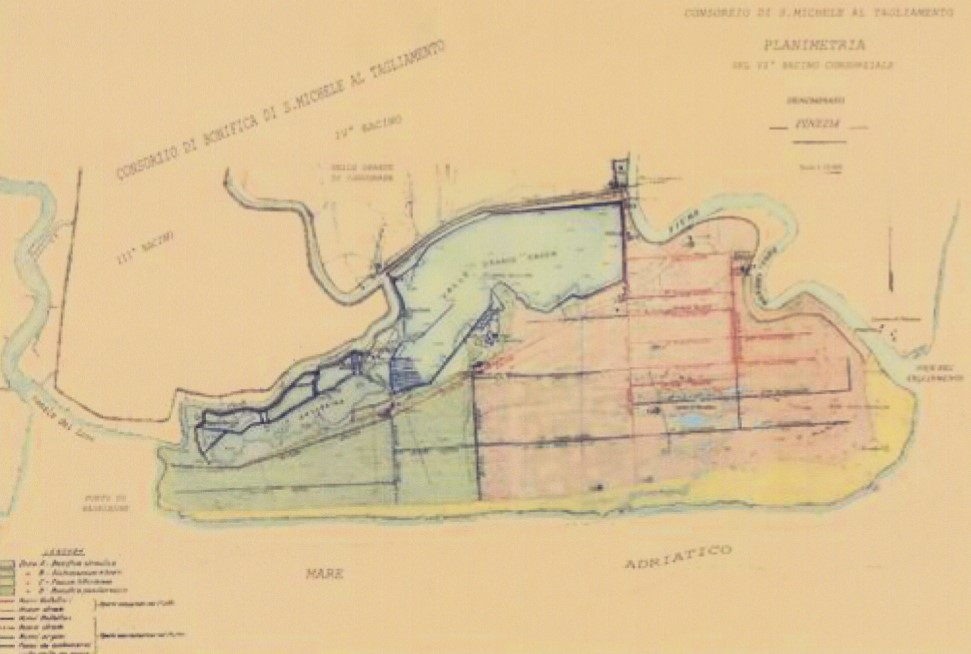
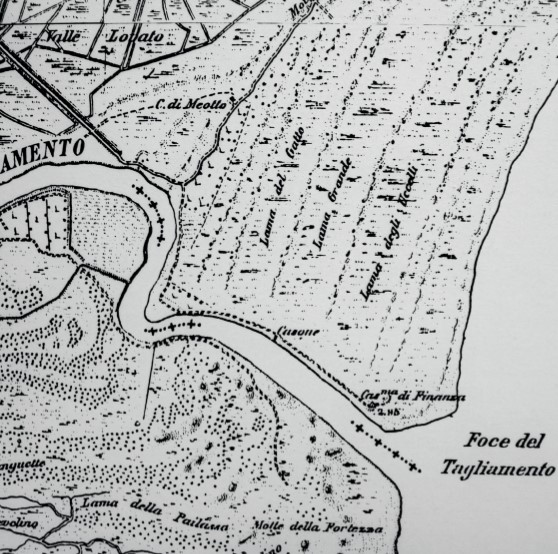
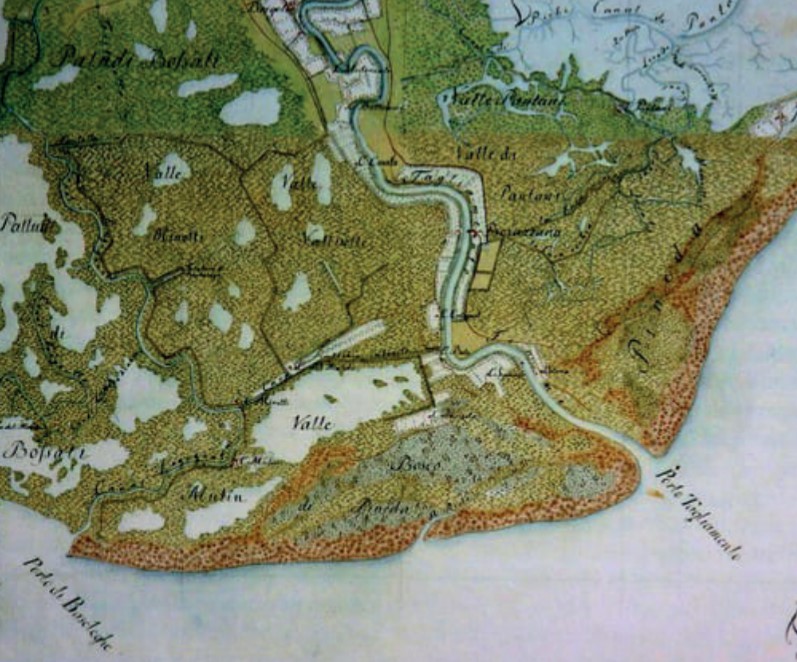
For centuries, this stretch of coastline was called Pigneda, Pineta or Pineda destra, due to the characteristic presence of a vast coastal pine wooded area.
The name by which we all recognise Bibione today was given in the mid-20th century, referring to ancient Venetian chronicles that identified this place as an ancient Venetian maritime centre.
The first documentary traces are dated 1439, the year in which Doge Francesco Foscari attributed the lagoon territory of public reason located between the Livenza and Tagliamento rivers to the inhabitants of Caorle. At that time, the town of Caorle was the only Venetian settlement on that stretch of coast.
In 1480, the excavation of the Cava canal began, which would allow the connection from the Lugugnana canal to the Tagliamento river. This work was considered important to allow inland navigation and in fact made today’s Bibione an island.
Some fifty years later, the entire area was confiscated and subjugated to the Venetian Arsenal by the Council of Ten. In fact, we know that on 7 October 1534, Doge Andrea Gritti ordered the area to be maintained or reduced to woodland with the planting of oaks or other essences. Woods, and therefore timber, were in fact considered an essential asset for Venice.
Only ten years later, around 1543, the area was sold to the Venetian Cappello nobles, who in turn sold the property to the nobleman Antonio Molin of Venice in 1574.
Under this owner, in 1593, the excavation of a new navigable canal called ‘Cava Nuova’ was completed, but it was soon abandoned because it was subject to silting up during river floods.
For more than 150 years, the property remained in the hands of the Molin family and did not undergo any particular changes. In 1760, Lorenzo Molin, the new owner of Pigneda, discovered wall remains near what is now Val Grande.
He thought it was an ancient convent located among the high dunes and ‘christened’ it: Mottaron dei frari.
It would only be discovered much later that these were the ancient remains of a maritime villa from Roman times, but most probably a sacred site dedicated to Santa Maria della Luvigiana was present in ancient times near Baseleghe.
We have a glimpse of what this area was like from the writings of Jacopo Filasi. The Venetian historian, in his ‘Memorie storiche de’ Veneti primi e secondi’, describes the place thus:
‘In the deserted sands between the lagoon of Grado and Caorle stood many littoral forests of pines, many maritime pinewoods, thick and vigorous, which adorned the town, and many products gave to the inhabitants. The ancient tribunes and doges hunted wild boars, martens, pheasants and peregrine falcons, and these woods were perhaps branches of the famous Selva Caprulana (Caprulan Forest), where the wild goat used to exist… An ill-conceived private interest destroyed these pinewoods, of which some remnants can be seen on both sides of the Tagliamento river, where a vast and sunny plain of almost 5,000 fields is still called Pineda.
In 1813, on the death of Vettor Molin, the last member of the noble Venetian family, the Pigneda property passed into the hands of the Giusti, Pisani and Cappello families.
Not long afterwards, in 1850, Count Francesco Giusti of Padua’s garden, son of Paola Molin, sold his part of the inheritance to Angelo and Giovanni Costantini of Burano, who subsequently bought the entire Pigneda property and sought to improve the valley aspect for fish production.
Parallel to this, they started a breeding of horses in the wild. Less than 30 years later, on 4 March 1879, the Costantini sold the entire property to Count Antonio Caccia of Trieste. The Count continued the valley activity that had already been started and obtained the exclusive right to fish for fresh fish at the expense of the Caorle fishing consortium.
Upon Count Caccia’s death in Lugano, Switzerland in 1893, his will stipulated that the entire Pigneda property be donated to the Municipality of Udine, which was, however, to allocate half of the proceeds to charitable works for the poor and local kindergartens, and that his stepson Captain Ugo Bedinello be retained as usufructuary.
Unfortunately, in the years that followed, the area experienced a period of neglect, punctuated by the looting of 1917-1918 during the Austrian occupation.
In 1925, the year of the death of Captain Cavalier Ugo Bedinello, the Municipality of Udine became solely responsible for the property; in his writings of that same year, the Prefectural Commissioner of the Municipality detailed the degradation of the area.
It was in 1926 that the Municipality of Udine sold the area to the S.A.C.A., S.A.F.A and S.A.PI.DE companies. The first worked to make some land cultivable, the second created poplar plantations and the third built the first network of roads and constructed the first housing units for tourist use, initially intended for Zanussi workers in Pordenone.


In 1927, S.A.PI.DE. sold the present Val Grande and Vallesina for 1,230,000 lire to Luigi Zoli and Carlo Pellegrini, the latter later liquidating the partner and remaining the sole owner.
Other plots of land were sold during the 1930s by the Municipality of Udine to the association of fighters and veterans, to the Municipality of San Michele al Tagliamento, and to the private Zelindo Mecchia. However, the land in the present-day Val Grande and Vallesina remained the property of the Pellegrini family until 1939, when it was sold to Count Gerolamo Nani Mocenigo of Cervarese Santa Croce di Padova.
The latter immediately began major hydraulic works, also activating the San Michele al Tagliamento land reclamation consortium; the works were completed eight years later, in 1947.
Upon the death of Count Nani Mocenigo, the property passed to his heirs, up to Giacomo Ferri de Lazara. In 1952, the splitting up of the properties of what was then called Pineda Destra began. The property of Val Grande is still owned by the Ferri de Lazara family, its current ‘exploitation’ is as a fishing valley, a hunting reserve and only in recent years, also thanks to the management participation of the Carrer family of partial tourist use.
Coming to the present day, since 2024 the company Bibione Spiaggia S.R.L. has become the lessee of the Val Grande area, establishing the current “Oasi Naturalistica Val Grande.”
The company’s commitment is realized in two parallel fields: tourism accessibility and environmental conservation.
In fact, since 2024, Val Grande has been open to the public and can be visited in a controlled and regulated manner throughout the year. This has allowed the public to discover, admire, and enjoy an exceptional natural heritage that has never been accessible in this way until now. Furthermore, the project serves the entire community of the Municipality of San Michele al Tagliamento and neighboring municipalities by guaranteeing a public service year-round.
Thanks to the professional figures present within the Oasis, visitors can enrich their visit with precious information, insights, and curiosities, which also help spread awareness about the area’s importance.
Indeed, thanks to this significant project, several actions are underway to restore and improve the habitats within the area, which are of extreme naturalistic importance and require necessary protection.
A forward-thinking project, recently established but with a great future ahead.